Why black holes fascinate scientists
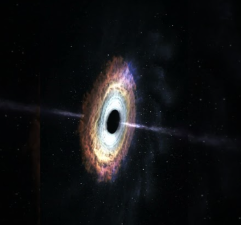
Black holes, one of the most mysterious and fascinating entities in the universe, have long inspired scientists' infinite curiosity and desire to explore. They are like invisible giants in the universe, devouring all matter and light that dare to approach, so that we can only indirectly infer their existence by observing the behavior of matter around them. A black hole is a celestial body formed by the collapse of a massive star at the end of its life. Its gravity is so strong that no matter, not even light, can escape within its event horizon. Imagine a star with a mass tens or even hundreds of times greater than that of the sun. After running out of fuel, its own gravity begins to ruthlessly squeeze matter until all matter is compressed to a tiny point, which is called a singularity. The strong gravitational field formed around the singularity is like a huge vortex, sucking everything around it in.
Observing black holes
A gentle trap that distorts space-time
The challenges and significance of exploring black holes
-
 Popular Science
Deep-sea discoveries reveal ancient secrets
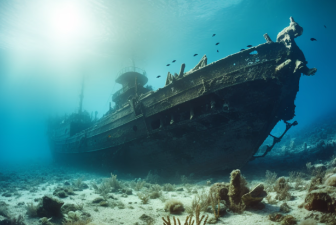
Students who love ancient civilizations should know that the earliest human civilization is believed to have originated from the Sumerians in the Mesopotamian Basin. The Sumerian civilization, which invented cuneiform, is about 8,000 years old. After more than 3,000 years, it was replaced by the Babylonian civilization. However, at the end of the last century, an underwater relic discovered near the Ryukyu Islands in Japan is likely to completely subvert the cognition of human civilization.What secrets are hidden in this suspicious deep-sea relic? In the southernmost part of Japan, further south than Okinawa Island, there is a small island called Yonaguni. The island is located at the westernmost end of the Yaeyama Islands in the Ryukyu Islands. From the map, it is on the edge of the continental shelf, only one step away from Taiwan Island. Yonaguni Island has an area of about 28.88 square kilometers, a coastline of about 28 kilometers, a population of about 1,745, and an average annual temperature of 23.9℃. Due to the strong southerly wind blowing on the island all year round, the erosion of the southern coast is more obvious, and most of them are cliffs. Nishizaki in the west is the westernmost cape of Japan, and there is a monument that reads "Japan - the westernmost place - Yonaguni Island".
-
 Popular Science
The Arctic Is Melting Faster Than Expected
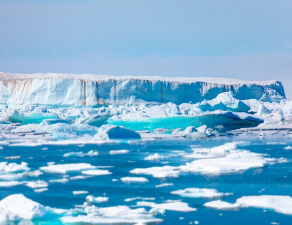
The Arctic could see its first ice-free summer day by 2027, exacerbating global warming and extreme weather. The Arctic could see its first summer as early as 2027, with nearly all of its sea ice melted away — a troubling milestone for the planet. For the first time, an international team of researchers, led by the University of Colorado and the University of Gothenburg in Sweden, used computer models to predict when the northernmost ocean would see its first ice-free day. An ice-free Arctic could have major impacts on ecosystems and Earth’s climate by altering weather patterns.
-
 Popular Science
Is smell your most powerful memory trigger?
Have you ever had a smell that has touched you so deeply that you still can't forget it? I believe many people have had such an experience. In fact, 75% of human emotions are closely connected to the sense of smell, which can be called a loyal guardian of memory. Each smell may carry a unique memory story, and they are like a portal in time, leading us to travel through time and space and return to the past.